|
Photos
(Click
to enlarge)
|
Description
|
Price
|
|
Click small photo
to see larger photo.
|
TO
PLACE AN ORDER:
If you wish to make a purchase, please send an email to yeoldecoinco@gmail.com
or telephone, Midday
to 6pm AEST - Monday to Friday,
08
8165 3446 to
confirm your purchase.
If necessary, leave a
phone message and a time to call and you will be answered. We know that sometimes there are a lot of coins marked Sold
in this section of the website. It is a popular area with collectors
and authentic stock can be hard to get. Many of the coins marked as Sold
are left there as a reference to collectors to give an idea of
the items available in this area of early Australian related coinage.
The
Australian Proclamation
of 1800 fixed 11 world
coin values in Australia at a higher value than overseas. This
was an attempt to keep overseas coins circulating in Australia, due to the dire shortage of currency. The
coins mentioned in the Proclamation were: Portuguese
Johanna &
Half Johanna, Netherlands
Ducat & Guilden, Indian
Mohur, Pagoda & Rupee, Spanish
Dollar, Great
Britain
Guinea, Shilling and Penny. These
11 coin values all had a higher value in Australia than elsewhere
during the
period 1800-1825. The Johanna and Half Johanna and the Spanish Dollars
and Dutch guilders and Ducats were all widely traded world
silver or gold trade coinage of the period. A consignement of
Spanish Dollars was used to produce the Holey Dollar & Dump,
Australia's first locally made coinage in 1813. Fractionals and different types of the
above mentioned coins were accepted and were in very short supply. Rum was often used as currency during this time. Spanish
Gold coins were often traded. It was more to do with the gold/silver
content of the coin than the actual coin itself. Coins of this period
had no borders. Their precious metal content was their value... The Australian
Proclamation coinage values were repealed by the Monetary Act of 1825,
following the introduction of quantities of British coins produced
after 1816. British
coins of nearly any
denomination available were traded in Australia during the
Proclamation period, 1788 - 1825 and most were readily accepted as
currency right up to about 1920, after which British silver
coins began to have considerably less silver content than
Australian coins. British copper and .925 silver coins were still found in Australian change right up to the 1960s
Transportation
of convicts to Australia began with the first fleet in 1788 and ended
with the coming of the Gold Rush in the early 1850s. Transportation
was, in fact, another version of slavery and many were harshly
sentenced for comparatively minor crimes. It was a source of cheap
labour and a chance for England to rid itself of excess population,
caused in part by the Industrial Revolution. But, from those humble
beginnings, a country unique in the world has developed, with a
history and culture stretching back far before 1788.
|
Aust
|
|

|
Photocopies
of the chapter of
"Proclamation" coins 1788-1825, by Greg McDonald
(Australia's
foremost numismatic author).
His highly informative and well researched 10 page essay
reproduced here for your education on this fascinating series.
Prices are WAY out of date (written 1991) but the background
info is truly fascinating. Post included. Repo with author's permission.
|
$10
for
10
page
essay
|
|
Click on thumbnail image to see larger
photo.
|
Silver Pieces
of eight or
Spanish 8 reales and their fractions, were traded widely between
1550 and 1850 and adopted as currency by a number of countries
including Australia... Machine made pieces of eight or dollars were
legal tender in Australia, 1788-1825. Spanish gold coins also circulated widely during this period.
|
$
|
| SPAINISH Dollars or "Pieces of Eight" and fractionals. | $ |

 | SPAIN - 1808 Charles IV Peru Bust Dollar or "Piece of Eight" .900 silver, KM 97, Good Very Fine. | Sold |
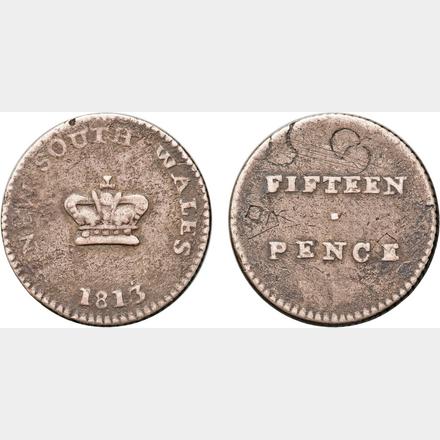 | 1813 NSW Dump or fifteen pence.
Type A/1, Full crown and
the majority of obverse legend evident, full reverse legend. Near VF
and a superior example for the type, very scarce in this grade. The first small
change coin produced by Australia, only about 1000 have survived, most
in poorer condition than this.
Ex
J.L.Griffin Collection and Reserve Bank of New Zealand Collection. Previously from the Rare Coin
Company, which sold the coin to the previous owner, back in 2010 for $125,000. With paperwork and certificate. EX ACA 352/2183. | Sold |

 | 1813 NSW Holey Dollar & Dump.
Pewter
with antique finish, 40mm & 18mm. Nicely detailed reproductions of
the first coin types made in Australia, the originals cost $200,000+
these days.. | $25 |
| Spanish & Portugese gold coins from the Proclamation period. | |

 | Portugal,
Brazil, 1732M
Gold Johanna.
John
V (1706-1750), gold 12800 Reis, Minas Gerais mint. 28.68g. Good Very Fine.
KM-139, rare & impressive large size gold coin, the king of the Australian
proclamation series. | Sold |
 | Portugal, Maria I & Pedro Gold 6400 reis or Half Johanna, 1780.
Lisbon mint. 14.30g. KM-271, Fr 107. Nice attractive coin, Extremely Fine. | Sold |
  | GB
18th century Half Johanna coin weight for 36 shillings.
In brass, 24mm diameter, VF. | $35 |
| Netherlands coins from the Proclamation period. | |
 | NETHERLANDS. HOLLAND. 1788 Gold Ducat. 22mm, 3.45 grams. KM-12.3. Very Fine. Famous trade coinage. Australian Proclamation coin. | Sold |
  | NETHERLANDS. 1723, Silver Guilder, Crowned arms rev standing female leaning
on column holding pole with cap. Near Very Fine. | $125 |
  | NETHERLANDS. 1792 West Friesland, Silver Guilder, Crowned arms rev standing female leaning
on column holding pole with cap. KM-97.5. Good Very Fine. | $295 |
 | NETHERLANDS. 1793 West Friesland, Silver Guilder, Crowned arms rev standing female leaning
on column holding pole with cap. KM-97.5. aEF/EF. | $275 |
|
Click thumbnail to get larger image.
|
INDIAN
coins traded
as legal tender in Australia during this period 1800-1825
|
$
|
  | INDIA, Aurangzeb Alamgir silver rupee. 1658-1707 period. Reverse punch mark otherwise VF. Australian Proclamation period coinage. | $40 |
  | INDIA, Aurangzeb Alamgir silver rupee. 1658-1707 period. Good VF. Australian Proclamation period coinage. | $55 |

 | INDIA, Mughal, Muhammad Shah silver rupees. 1719-1748 period. A small hoard, Fine to VF grades. Australian Proclamation period coinage. | $50
each |
  | INDIA, Bengal Presidency 1793 silver rupee. Murishidabad Mint. Year 19. Oblique milled edge, KM 98.1. Good Very Fine. Australian Proclamation period coin. | $175 |
  | INDIA, Bombay, Shah Alam II 1759-1806 silver rupee. KM 90.1. Extremely Fine. Australian Proclamation period coin. | $100 |
  | INDIA, Madras Presidency, East India Company, gold star pagoda, (1740-1807) 12mm, 3.36 grams. KM #303. Australian Proclamation Coin. Good VF. |
Sold
|
 | India. Gold Mohur of the Benghal Presidency
1793. East India Company Gold Mohur, 26mm, 12.36 grams. Murshidabad
(Calcutta) mint. Dated AH 1202; RY 19 of Shah Alam II Couplet in five
lines; AH date in lower field; mint secret mark present / “Struck
Murshidabad year 19 of reign associated with prosperity” in Arabic.
Edge: grained left. KM 102. Fully lustrous, UNC. Australian Proclamation coin. | Sold |
|
Click photo to enlarge.
|
British coins
from Guinea to farthing, 1662-1825. These
were what was mostly traded in colonial Australia. More British
coins from this period available in the "Machine Made Coins" section of this website. Listed mostly in order of
denomination descending from Guinea to farthing.
|
Aust
|
  | GB. Sir Joseph Banks 1820. (38mm,
32 g). Silver Prize medal, uninscribed, bearing a fine portrait of
Joseph Banks, with a rich antique tone. Extremely Fine.
Sir
Joseph Banks, 1st Baronet, GCB, PRS
(13 February 1743 – 19 June 1820) was an British naturalist, botanist and
patron of the natural sciences. He took part in Captain James Cook's first
great voyage (1768–1771). Banks is credited with the introduction to the
Western world of eucalyptus, acacia, mimosa, and the genus named after him,
Banksia. Approximately 80 species of plants bear Banks's name. Banks was also
the leading founder of the African Association, a British organization dedicated
to the exploration of Africa, and a member of the Society of Dilettanti, which
helped to establish the Royal
Academy.
It was Banks's own time in Australia,
however, that led to his interest in the British colonisation of that
continent. He was to be the greatest proponent of settlement in New South Wales, as is hinted by its early colloquial
name, Botany Bay. The identification might
have been even closer, as the name "Banksia" was proposed for the
region by Linnaeus. In the end a genus of Proteaceae was named in his honour as
Banksia. In 1779 Banks, giving evidence before a committee of the House
of Commons, had stated that in his opinion the place most eligible for the
reception of convicts "was Botany Bay, on the coast of New
Holland". His interest did not stop there, for when the
settlement was made, and for 20 years afterwards, his fostering care and
influence was always being exercised. He was in fact the general adviser to the
government on all Australian matters. He arranged that a large number of useful
trees and plants should be sent out in the supply ship Guardian which, however,
was wrecked, and every vessel that came from New South Wales brought plants or animals or
geological and other specimens to Banks. He was continually called on for help
in developing the agriculture and trade of the colony, and his influence was
used in connection with the sending out of early free settlers, one of whom, a
young gardener George Suttor, afterwards wrote a memoir of Banks. The three
early governors, Arthur Phillip, John Hunter, and Philip Gidley King, were
continually in correspondence with him. He was interested in the explorations
of Matthew Flinders, George Bass and Lieutenant James Grant, and among his paid
helpers were George Caley, Robert Brown and Allan Cunningham. | $100 |

| GB. George III. 1760-1820. Silver Emergency Issue Dollar. Oval countermark in the centre of obverse of Charles IIII Mexico Mint eight reales, 1792, Fine, some marks, scarce.
In the late 18th century, the circulating coinage in Britain was in a pathetic
state. Counterfeit coins, both in copper and silver, were the rule, rather than
the exception. The Royal mint, rather than competing with the flood of false
issues, simply shut its doors.
In 1788, industrialist Matthew Boulton
stepped in to attempt reform the copper coinage where the government would not.
A wealthy industrialist and partner of the steam-engine inventor James Watt,
Boulton had made his fortune manufacturing other small metallic objects. Using
the steam technology at his disposal, he created the first modern mint at Soho
in Birmingham. Yet Boulton was initially unable to obtain a patent to strike
coinage and instead opened his mint to merchants. The vast majority of
provincial tokens struck in England at this time originated from the Soho
mint.
Meanwhile,
the Bank of England endeavored to stabilize the silver coinage. Taking
Spanish eight reales coins, they stamped on them a small image of King
George, valuing them at a dollar or five shillings. This simple
solution did not fare well with the public; the silver value of these
coins being only about 4s and 4d. The failed issue spawned a
popular rhyme, “The Bank to make their Spanish dollars pass,
stamped the head of a fool on the neck of an ass.” The Bank soon turned
to Boulton and his steam presses. By 1805, fully struck 1804 dollars from the Soho mint could be seen in change. | Sold |
  | GB.
George III. 1820 silver crown. S 3787. What appears to be a natural metal flaw in field at 3 o'clock on Obverse, circulated, aVG. | $125 |
  | GB.
George III. 1811 3s Bank Token. S 3769. Bust draped in armour type, with some underlying lustre, Extremely Fine. | $195 |
  | GB.
George III. 1787 Shilling.
S
3743. No hearts. Near Very Fine. | $165 |
 | GB.
George III. 1787 Shilling.
S
3743. No hearts. Good Very Fine. | $195 |
  | GB.
George III. 1787 Shilling.
S
3746. With semee of hearts. Extremely Fine. | $250 |
  | GB.
George III. 1816 Shilling.
S 3790. Circulated, Fine/VG. | $35 |
  | GB.
George III. 1817 Shilling.
S 3790. Near VF. | $65 |
|
Click smaller photo to see larger
photo.
|
Official Great
Britain copper
coins
from George I, II & III circulated very widely in Australia and
America, pre 1825. 1797 Cartwheel pennies and 2d were much used and
some were defaced as a sign of anger towards Geo III, some were made
into smugglers coins, some into love tokens, also they were often used
as weights, as they weighed exactly 1 oz for the 1d and 2 oz for the
2d. The penny forms part of the Australian Proclamation Coin series
used 1800-1825 period.
|
$
|
| Click small photo to see larger photo. | Australian convict and colonial era small change coinage, c 1788-1830s period pennies, halfpennies, farthings. | $ |
  | GB.
1797. Cartwheel Twopenny. S
3776. Overall, better than average with excellent detail, gVF, 40mm diameter. The first coins made in Great
Britain using the steam press by Watt & Boulton and
historically interesting as such. Could be used as a weight, the
1d weighs 1oz and the 2d is 2 oz. Could be used as a measure.
Were unpopular as currency because of their weight. Used in
Colonial Australia & 18th early 19th century America. | Sold |
  | GB.
George III 1797 Cartwheel Penny. S
3777. Australian Proclamation coin, Dcent mid grade, Very Fine.
First coins made
in Great Britain using the steam press by Watt & Boulton and historically
interesting as such. Could be used as a weight, the 1d weighs 1oz and the 2d is
2 oz. Could be used as a measure. Were unpopular as currency because of their
weight. Used in Colonial Australia & 18th early 19th century
America. | $150 |
| Convict and other colonial period related items. | |

| GB, CAPTAIN JAMES COOK. 1784 Bronze medal by Pingo. 43mm.
(MH 374, BHM 258, Eimer 780) Near UNC with lustre and rare, only 577 made, sold
at the time of minting for Half a Guinea (10s 6d)
James Cook had first seen the Americas when, as a Master of the Mercury he
surveyed the St Lawrence River as part of General Wolf's Expedition to capture
Quebec. He continued to serve on the North American station until 1767. He twice
circumnavigated the world, first in 1768-71 and later 1772-1775. Discovered the east coast of Australia in 1770. He had left on
his 3rd voyage in 1776 and was killed by natives of the Sandwich islands in
1779. The Royal Society issued this medal in 1784 in the following quantities -
Gold 19, Silver 291 and Bronzed Copper 577. | $950 |

 | Convict perid. 1823 Van Diemens Land one shilling banknote.
Currency Note, John Weavell, one shilling, Hobart
Town (Dec 1) 182(3) No (53) (MVR fig. 172). Struck down to backing
paper, horizontal tear right across, frail edge, otherwise good and
nearly a full note and very rare.
Some
numismatic history here. Originally sold by Jim Noble in his first 1977
sale. 47 Years later Jim & Colin are still flying the flag for
numismatics here in Australia. National treasures both.. | Sold |
 | Convict: Van Diemen's Land:
1850s
Ticket of Leave (a pass to allow convict to travel between his place of
work & designated destination) issued by Police Office in closest
town. Original unissued form printed in black on wove paper with
counterfoil. Approx 110 x 200mm. Minor ageing, gVF. Scarce. | $225 |
 | Convict. 1853 Cessation of Transportation medal. White metal, 58mm, Carlisle 1853/2. A few small blemishes but a nice bold strike, VF.
Ex D.G.L Worland collection, NN 140/482. | $395 |
| | |