|
Photos
(Click
to enlarge)
|
Description
|
Price
|
|
Click
small
photo
to see larger
image.
|
Emails not currently working - we are trying to resolve it, not having much success. Phone 08 8165 3446 between noon and 6pm. TO
PLACE AN ORDER:
To make a purchase, please send an email to Richard & Su at oldcoins@senet.com.au
or telephone, Midday
to 6pm AEST - Monday to Friday, 08
81653446 to
confirm your purchase. If necessary, leave a phone message and a
time to call and you will be answered.
In
the descriptions, AR refers to
silver,
AE to copper
or bronze and AV to gold.
Cheaper Ancients
available - listed further
down this list...
Listed in order of age.
|
Aust
$
|
 | Mysia, Kyzikos, (c.525-475 B.C.), silver hemiobol, (10mm, 0.41 g), obv.
forepart of boar to left, to right, tunny upward, rev. head of lion
left, star above nose, within incuse square, (cf.S.3850, Von Fritze II
-, SNG BN 375). Lightly toned, some surface porosity, good very fine and
rare. Ex Anthony (Tony) Taylor Collection. Charming, tiny ancient coin.
NN 140/2282 | $150 |
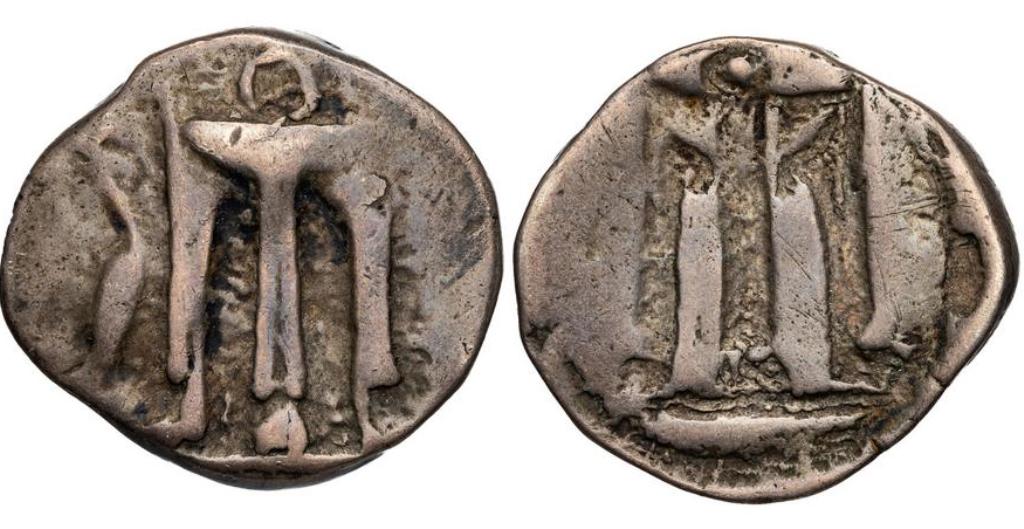 | BRUTTIUM, Kroton, 480-430 BC. Silver Nomos.
(20mm, 7.79g) Tripod terminating in Lion's feet, Heron to left/Incuse
of tripod. HN Italy 2102. All devices clear, a nice Example of the
Kroton tripod incuse type, Very Fine.
Ex RB 142/1833 | $450 |

 | Attica, Athens
449-413BC Silver Tetradrachm (23mm,
17.04g). Head of Athena right wearing ivy crested helmet rev Owl
standing right head facing, S-2526. Kroll 8. Good Very Fine. Famous trade coinage of the Classical period.
Ex Antiquarius, NZ. | Sold |


| Thrace, Thasos, (c.early 5th century B.C.), silver stater,
(20mm, 9.19 g), obv. naked ithyphallic satyr (classical style) in kneeling
running attitude carrying off nymph raising hand in protest, rev.
quadripartite incuse square, (S.1746, Asyut Hoard -, BMC 24, McClean
4197, SNG Cop. 1010, ACNAC Dewing 1322, HGC 6, 331). Toned, very fine
with good facial and hand detail, very scarce. Ex NN Sale 135/4089 and French auction company with tickets. | $650 |
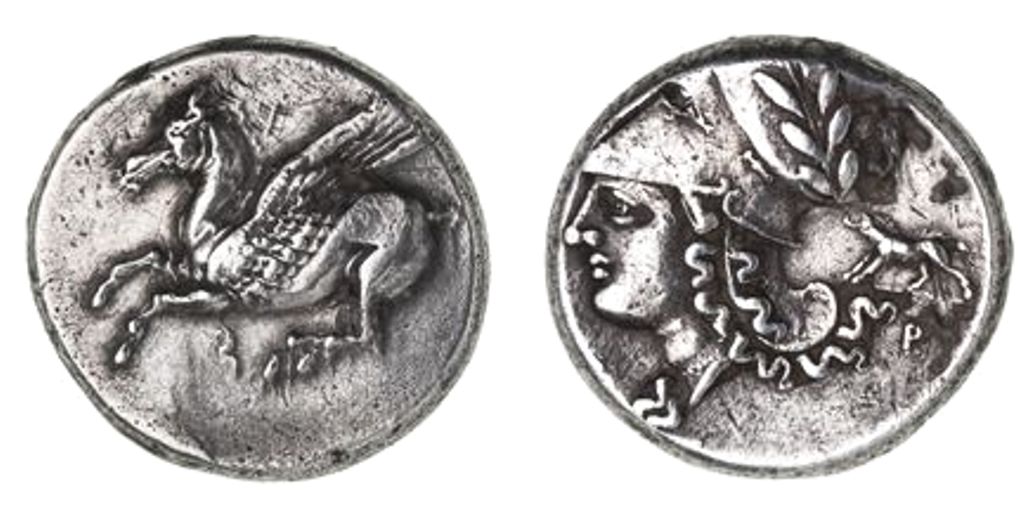 | Corinthia, Corinth, (c.375-300 BC), silver stater (20mm, 8.55g), obv. Pegasos
flying left, Q below, rev. head of Athena left, wearing a laureate
Corinthian helmet, boar standing on ground line left to right of
neckguard, [A]-P below (Ravel 781; HGC 4 1837; Calciati 435). Toned,
very fine. Ex Stephen J. Bridges Collection. NN 140/2265. | $795 |
 | Macedon, Kingdom of, Philip II, (359-336 B.C.), silver tetradrachm,
(26mm, 14.41 g), Amphipolis Mint, issued posthumously 342/1-329/8 B.C., obv.
head of Zeus laureate to right, rev. naked youth or small man (Philip
II), on horseback to right, prow below in field, around and above FILIP
POU, (cf.S.6680, Le Rider Pl.38, 376a [same dies and This Coin
illustrated]). Superb portrait of Zeus, in high relief, attractive dark
tone, good very fine and rare.
Previously David Worland Collection and previously from The American Numismatic Society and formerly
from the Edward Newell Collection. | $1850 |
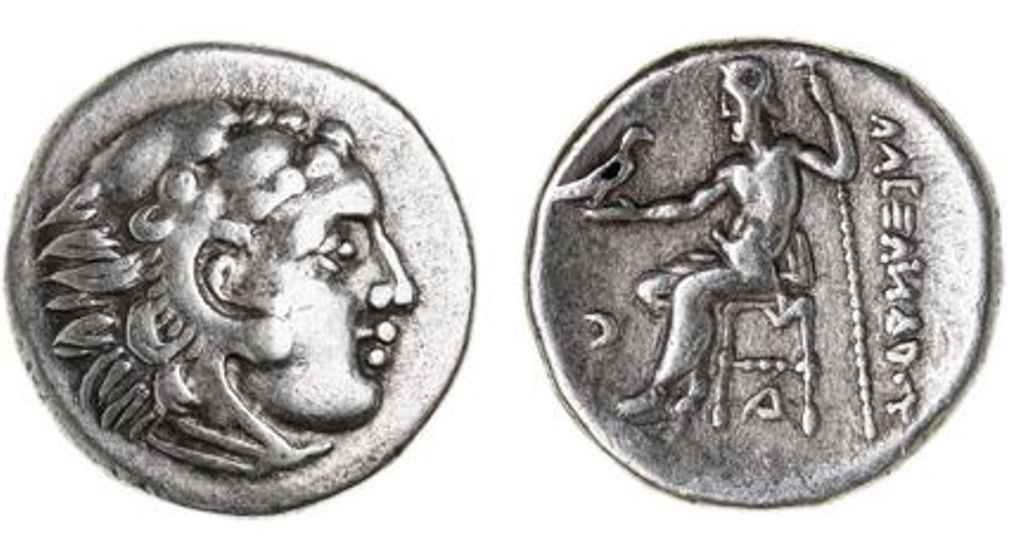 | Macedon, Kingdom of, Alexander III, (336-323 B.C.), silver drachm, (18mm, 3.41
g), "Colophon" Mint, barbarous issue issued late 4th century B.C., obv.
head of Herakles to right wearing lion skin with dotted border, rev.
Zeus seated on throne to left, eagle in outstretched hand, A or D below
throne, crescent to left, ALEXANDROU to right (N reversed), (cf.S.6730,
Price (1798a), BMC -, P.O.(1) 286). Very fine and very rare.
Ex Fred Shore, USA, January 18, 2003. Ex NN 140/2153. | $295 |
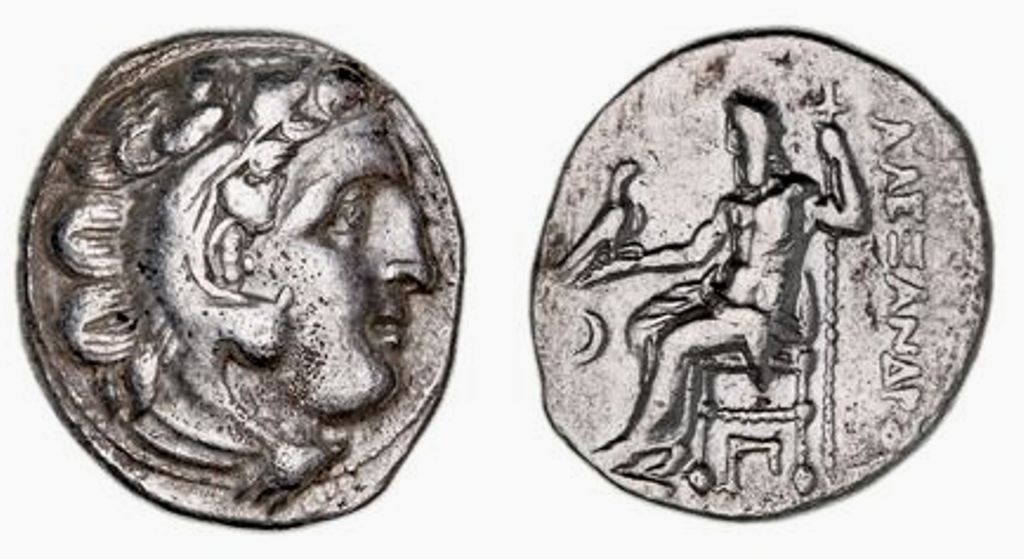 | Macedon, Kingdom of, Alexander III, (336-323 B.C.), silver drachm, (18mm, 4.43
g), Colophon Mint, issued 310-301 B.C., obv. head of Herakles to right
wearing lion skin, rev. Zeus seated on throne to left, eagle in
outstretched hand, crescent to left, P below throne, ALEXANDR[OU] to
right, (cf.S.6730, Price 1813, BMC 1813a-d, M.262, SNG Cop. 919). Good
very fine.
Ex NN 140/2156. | Sold |
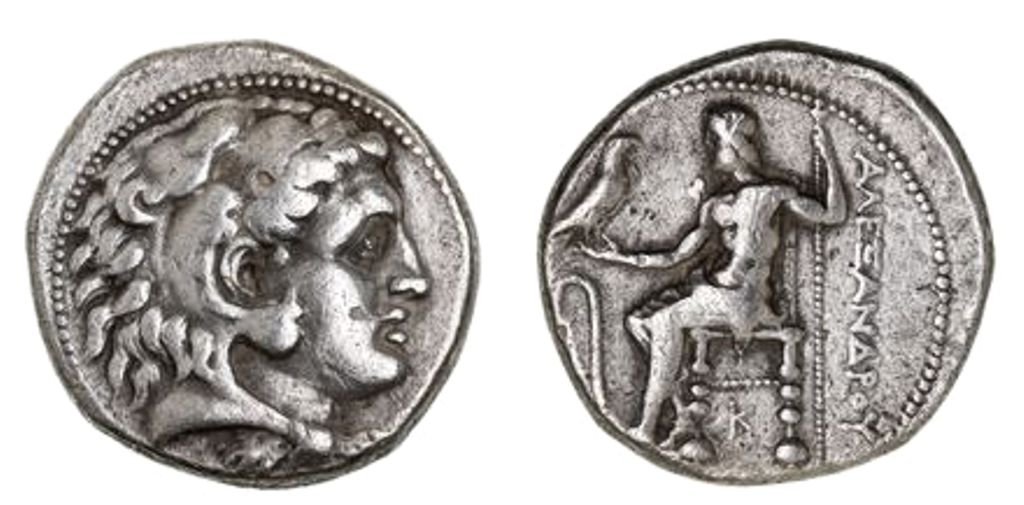 | Macedon, Kingdom of, Alexander III, (336-323 B.C.), silver tetradrachm,
(26mm, 16.98 g), uncertain southern mint, issued c.320-280 B.C., obv. head of
Herakles to right wearing lion skin with dotted border, rev. Zeus
Aetophoros seated on throne to left, lagobolon in left field, eagle in
outstretched hand, K below throne, ALEXANDROU to right, dotted border,
(cf.S.6713, Price 3070, SNG Saroglos -). Very fine or better, very rare
type. Ex Anthony (Tony) Taylor Collection. CNG 375/424, NN 140/2200. | $850 |
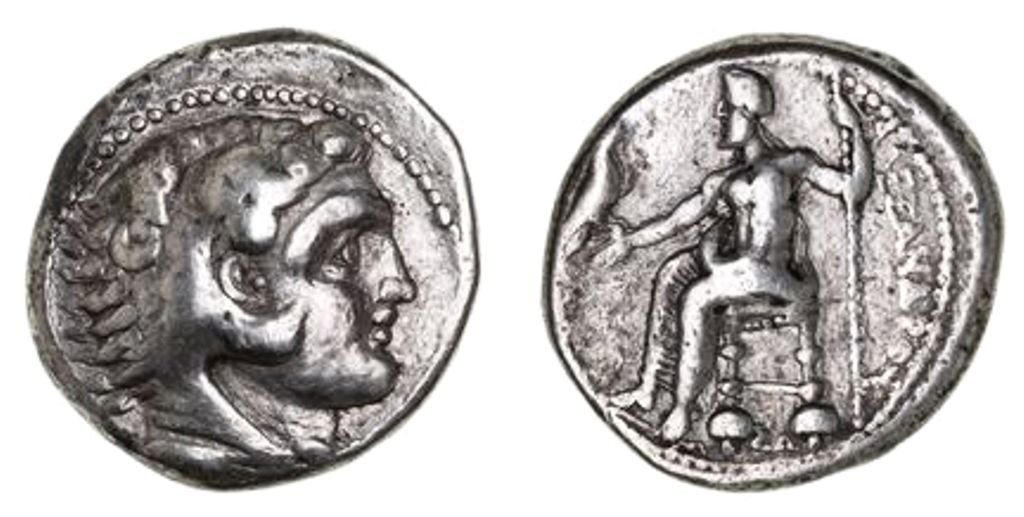 | Macedon, Kingdom of, Alexander III, (336-323 B.C.), silver tetradrachm,
(25mm, 17.00 g), Tyre Mint, undated issue, struck under Menon or Menes, circa
332/1-328/7 B.C., obv. head of Herakles to right wearing lion skin with
dotted border, rev. Zeus seated on throne to left, eagle in outstretched
hand, SW below throne, ALEXANDROU to right, (cf.S.6713, Price 3241,
Newell, Dated 4 [dies V/a]). Lightly toned, struck slightly off centre,
nearly very fine and very rare. Ex Anthony (Tony) Taylor Collection. CNG 391/89, NN 140/2198. | $950 |

 | MACEDON, Kingdom of, Alexander III, (336-323 B.C.) Gold stater, (18mm, 8.56
g), Carrhae Mint, issued c.305-300 B.C., obv. head of Athena to right in
crested Corinthian helmet, rev. Nike standing to left, holding wreath
and stylus, to left AP monogam in circle, crescent and DI below, to
right ALEXANDROU, (cf.S.6702, Price 3817, M.265). Good very fine and a
scarce variety.
Ex NN 135/4043
Alexander the
Great (356-323 BC), king of Macedonia, conqueror of the Persian Empire, and one of the greatest military
commanders of all time. Alexander was born in Pella, the ancient capital of
Macedonia, was the son of Philip II, king of Macedonia, and of Olympias, a
princess of Epirus. In the summer of 336 BC
Philip was assassinated, and Alexander ascended to the Macedonian throne. In 335
BC as general of the Greeks in a campaign against the Persians, originally
planned by his father, he carried out a successful campaign against the
defecting Thracians, penetrating to the Danube River. On his return he crushed in a
single week the threatening Illyrians and then hastened to Thebes, which had
revolted. He took the city by storm and razed it, sparing only the temples of
the gods and the house of the Greek lyric poet Pindar, and selling the surviving
inhabitants, about 8000 in number, into slavery. Alexander's promptness in
crushing the revolt of Thebes brought the other Greek states into
nstant and abject submission. Alexander began his war against
Persia in the spring of 334
BC by crossing the Hellespont (modern Dardanelles) with an army of 35,000Macedonian and Greek
troops; his chief officers, all Macedonians, included Antigonus, Ptolemy, and
Seleucus. At the river Granicus, near the ancient city of Troy, he attacked an army
of Persians and Greek mercenaries totaling 40,000 men. His forces defeated the
enemy and, according to tradition, lost only 110 men; after this battle all the
states of Asia Minor submitted to him.
Continuing to advance southward, Alexander encountered the main Persian army,
commanded by King Darius III, at Issus, in northeastern Syria. The
Battle of Issus,
in 333, ended in a great victory for Alexander. Cut off from his base, Darius
fled northward, abandoning his mother, wife, and children to Alexander, who
treated them with the respect due to royalty. Tyre, a strongly fortified
seaport, offered obstinate resistance, but Alexander took it by storm in 332
after a siege of seven months. Alexander captured Gaza next and then passed on
into Egypt, where he was greeted as a deliverer. By these successes he secured
control of the entire eastern Mediterranean coastline. Later in 332 he founded,
at the mouth of the Nile River, the city of Alexandria, which later became the literary,
scientific, and commercial center of the
Greek world. In order to complete his
conquest of the remnants of the Persian Empire, which had once included part of
western India, Alexander crossed the Indus River in the spring of 323 BC. In June he
contracted a fever and died. He left his empire, in his own words, “to the
strongest”; this ambiguous testament resulted in much conflict for over half a
century. | $7500 |
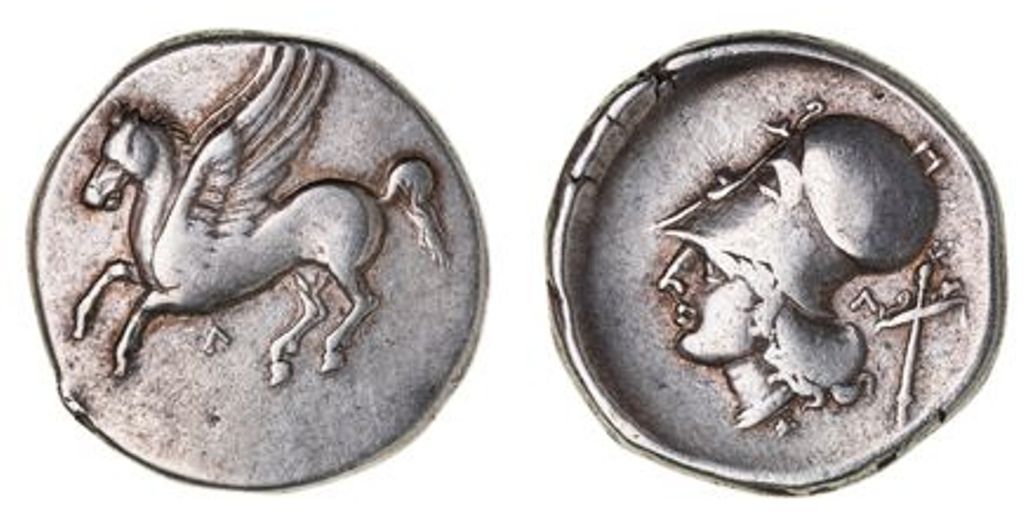 | ANCIENT GREECE. Arkanania, Leukas, (c.320-280 B.C.), silver stater, (23mm, 8.27 g), obv.
pegasos flying left, L below, rev. head of Athena wearing Corinthian
helmet, L and stylis to right (HGC 4 825, Calciati 132, BCD Akarnania
263-74). Lightly toned, nearly very fine.
NN 140/2235 | $750 |
 | Thrace, Kingdom of, Lysimachos, (305-281 B.C.), silver tetradrachm.
(30mm, 16.69 g), Herakleia Pontike Mint, issued 288/7-282/1 B.C., obv. head of
Alexander to right, with diadem and horn of Ammon, within dotted
circle, rev. Athena enthroned to left, supporting Nike, spear behind, HP
monogram on throne, club in exergue, to right [B]ASILEWS downwards, to
left LUSIMAXOU downwards, (cf.S.6814, Thompson 178, Muller 365, HGC 3
1750j). Lightly toned, very fine and rare.
Ex Tony Taylor collection, CNG 426/20, NN 140/2080. | $1500 |

 | EGYPT, Kingdom of, Ptolemy II, (285-246 B.C.), silver
tetradrachm (Lorber
describes as a stater), (25mm, 13.67 g), Sidon mint, year 251/250 B.C,
obv. head of Ptolemy I to right wearing aegis, rev. eagle to left with
closed wings, standing on thunderbolt, in front. S.7772, interesting
countermark in lower field, VF. Mentioned in the bible by Isaiah.
Ex Tom Kiernan collection. | Sold |

| BAKTRIA,
Greco-Baktrian Kingdom. Demetrios. Circa 205-171 BC. AE 29. Elephant right, bell hanging from neck. M 108b Seaby 7533, VF. | $175 |
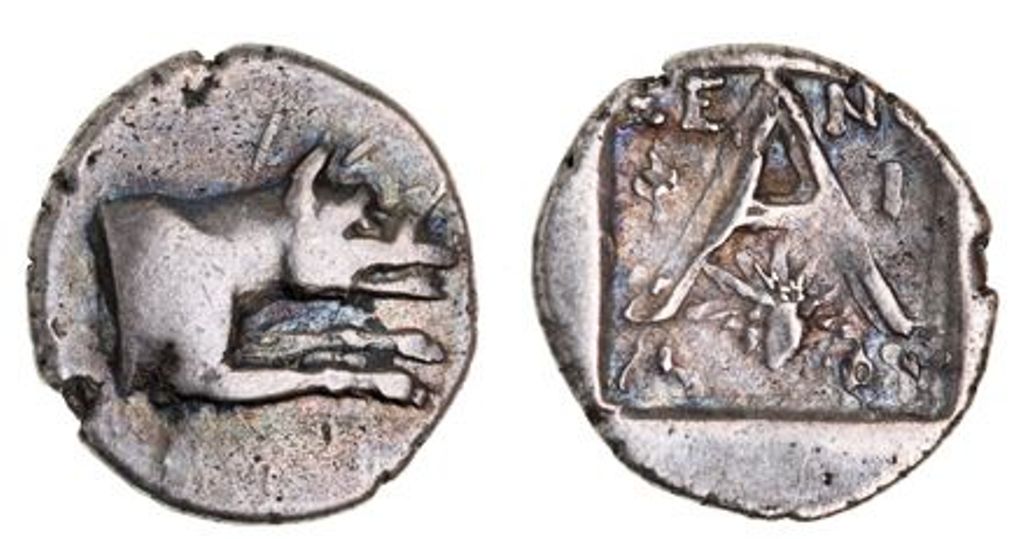 | Argolis, Argos, (after 125 B.C.), silver triobol, (15mm, 2.20 g), Xenophilos,
magistrate, ca.90-40 BC, obv. forepart of wolf at bay right, rev. large A
in centre, head of Helios facing below, XE NO FI L OY around (HGC 5
691, BCD Peloponnesos 1179). Rainbow toning in devices, very fine. Ex R. Pankhurst Collection. NN 140/2273. | $295 |
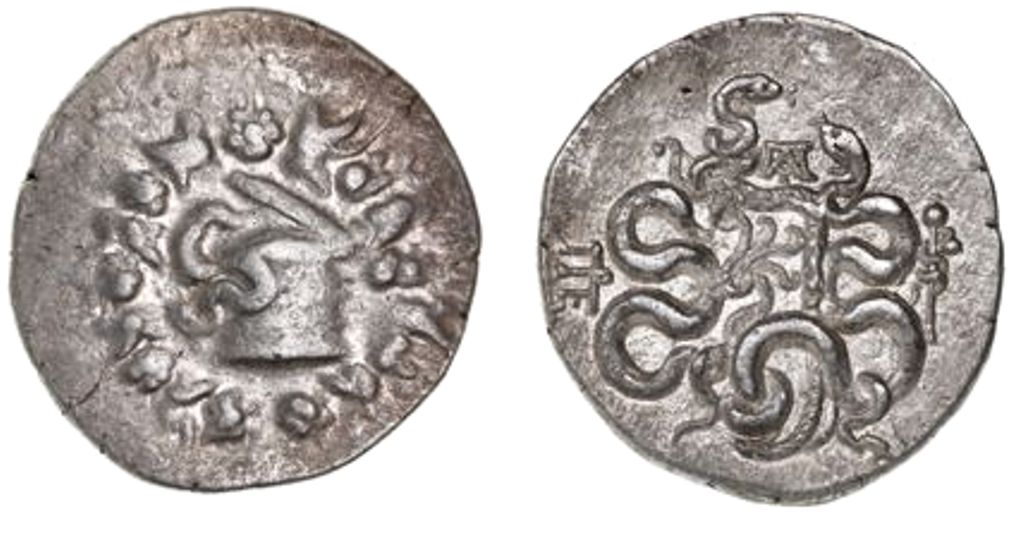 | Mysia, Pergamon, (104-98 B.C.), silver cistophoric tetradrachm, (29mm, 12.50
g), obv. cista mystica containing serpent, all within ivy wreath, rev.
bow in case between two coiled serpents, to left monogram of PER, above
MAY monogram, to right serpent entwined thyrsus, (cf.S.3948, Carbone,
Hidden Power, type XXXII (obv.79, rev. 150, p.63), [This Coin
illustrated on plate 1529], Kleiner [ANSMN 23], No.7). Good very
fine/nearly extremely fine and rare.
Ex the 2002 hoard, acquired from CNG in January 20, 2003. NN 140/2286 | $350 |
|
Click photo to enlarge.
|
Generally less
Expensive Ancient coins!
|
Aust
$
|
|

|
MOESIA,
Istros. Cast
Æ Wheel Coins. Late
5th century BC. All
coins: wheel (or solar disk) with four spokes and with raised
central hub / ΙΣΤ across field (often obscured).
Three different denominations available, per photos:
a)
Æ 15mm (weight ~2.50 – 3.25 g). SNG Black Sea 220;
SNG Stancomb 131. $75
b) Æ 11-12mm (~1.30 – 2.20
g). SNG Black Sea 221-222; SNG Stancomb 132. $55
c) Æ
7-9mm (~0.60 – 1.40 g). SNG Black Sea 223-224; SNG
Stancomb 133. $50
Average VF to Good VF condition, some
roughness, as usual.
|
$75
$55
$50
|


|
Ancient
Dolphin Money. MOESIA - OLBIA (Ukraine - Black Sea Coast)
circa 300-200 BC. S
1684. Cast bronze, approx 18 - 25mm, in the shape of a dolphin. Most
with usual missing or chipped tails. Unique coinage
type.
|
$25
ea
|

 | SICILY. Time of Timoleon, 344-336 BC. AE
Litra. 33.1 grams, 28mm. Obverse: Athena, Reverse: Starfish
between two dolphins. Nice reverse with good portrait of dolphins, Fine. Ex I.S Wright, Sydney. | $135 |

 | ANCIENT EGYPY, Ptolemy III (246-221BC).
AE 36, Head of Zeus, 36mm, 48.47 grams, Head of Zeus/Eagle. With interesting reverse counter stamp in left field, Fine. | Sold |


| ANCIENT EGYPY, Ptolemy VI (180-145BC).
AE 28, Head of Zeus, 28mm, 22.79 grams, Head of Zeus/Twin Eagles. Nice dusty old patina, Very Fine. | Sold |


| ANCIENT EGYPY, Ptolemy VIII (145-116BC).
AE 20 or Obol, Alexandria Mint. Head of Zeus, 20mm, Head of Zeus/Eagle on thunderbolt. Attractive, nice strike, Very Fine.
Ex Tom Kiernan collection. | Sold |
| | |